Chin Setback Surgery: A Comprehensive Guide to Correcting Protruding Chins for a Balanced Facial Profile
- Dr. Park

- Jan 18, 2025
- 3 min read
Are You Concerned About a Protruding Chin?
Chin Setback Surgery is an effective procedure designed to reposition an excessively protruded chin backward, improving overall facial harmony. This posting will provide a clear explanation of the benefits, process, potential risks, and recovery period associated with chin setback surgery.
What is Chin Setback Surgery?
Chin setback surgery involves repositioning a protruding chin backward to create a more balanced facial profile. Often performed in combination with chin reduction, the procedure removes a portion of the chin bone and shifts the remaining section backward and upward, as illustrated in the diagram below.

Who Needs Chin Setback Surgery?
This procedure is particularly suitable for individuals with an overly prominent chin that makes the face appear elongated from a side profile. A thorough assessment of the chin’s shape determines the necessity of the surgery. It is most effective for cases where the chin significantly protrudes forward, as shown in the example below:

Left Image: Effective for prominent, forward-projecting chins.
Right Image: Not recommended for naturally proportioned chins.
Additionally, achieving optimal results may be challenging when the mentolabial sulcus (the groove between the lower lip and chin) has an excessively steep angle.
The Aesthetic Importance of the Mentolabial Angle

The mentolabial sulcus plays a crucial role in facial aesthetics. For ideal results, this angle should be appropriately balanced. An overly steep mentolabial angle can lead to unnatural outcomes if treated solely with chin setback surgery. In such cases, double jaw surgery may be necessary to maintain the appropriate mentolabial angle.

Case Analysis
Hard and Soft Tissue Changes
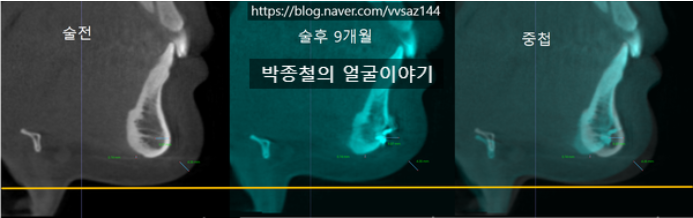
Comparative CT scans before and after surgery reveal restored facial profiles with an improved E-line and approximately 4mm distance between bone cut surfaces.Post-surgical images also demonstrate noticeable changes in the chin's position.

Changes in the position of the chin can also be observed in soft tissue images.

You can observe skeletal changes by comparing the preoperative and postoperative CT images.

Managing Double Chin and Sagging Skin Concerns
One common concern associated with chin setback surgery is the development of a double chin or sagging skin. However, clinical examples show that tissues under the chin are often repositioned upward rather than sagging downward.
Despite these results, some patients may perceive a double chin due to changes in soft tissue exposure.

Areas(red arrow) previously concealed by the chin bone may appear more prominent post-surgery. If necessary, adjunct procedures such as liposuction can help mitigate or prevent these issues.
Recovery Period
While swelling typically subsides within three months following contour surgeries, chin setback surgery may take over six months for soft tissues to stabilize. In this case, continuous improvements in soft tissue stabilization were observed up to nine months post-surgery.


Conclusion
Chin setback surgery effectively addresses aesthetic concerns caused by a protruding chin. However, careful preoperative evaluation and supplementary procedures may be required to address potential concerns like double chin development or skin sagging. Patience is essential, as full recovery and results can take several months to manifest.
Thank you for reading about chin setback surgery!


Comments