Sagging After Cheekbone Reduction: Is It Really Skin Elasticity? A CT Analysis of Soft Tissue Changes
- Dr. Park

- Dec 15, 2025
- 5 min read
Hello, this is Dr. Park Jong-chul, Oral and Maxillofacial Surgeon.
When consulting with patients planning facial contouring surgery—specifically cheekbone reduction (zygoma reduction)—the most common question and concern I hear is undoubtedly regarding "sagging" or "drooping cheeks."
Many patients hesitate after reading cheekbone reduction reviews that claim, "The facial width decreased, but I look older," or "My cheek flesh seems to have slid down." The prevailing belief is that this phenomenon is simply due to a loss of skin elasticity and gravity acting on loose skin after the bone size is reduced.
However, after tracking and analyzing long-term CT data from my patients, I have found that the reality of "sagging" perceived by patients is quite different. It is rarely just about skin stretching; rather, it is a visual phenomenon caused by the redistribution of soft tissue (skin, muscle, fat) following the movement of the bone.
Today, I will focus on analyzing the soft tissue changes in the 45-degree cheekbone area. We will explore how facial lines change after surgery and discuss ideal surgical planning to prevent that dreaded "sagging" appearance.
Quantitative Analysis: If the Bone Shrinks, How Much Does the Soft Tissue Shrink?
Cheekbone reduction involves cutting the protruding zygoma (bone) and moving it inward. Naturally, the soft tissue covering the bone moves along with it. However, the flesh does not retract 100% in proportion to the bone.
Based on a quantitative analysis of my patients' CT data, the soft tissue change (reflection rate) relative to bone movement in the 45-degree cheekbone area is approximately 60% to 80%.
Right Side: Bone moved inward 4.61mm → Soft tissue changed 3.71mm (approx. 80% reflection)
Left Side: Bone moved inward 3.41mm → Soft tissue changed 2.81mm (approx. 82% reflection)

CT Superimposition: Visualizing the Shift
When we superimpose pre-operative and post-operative CT scans, we can clearly see the correlation between the bone and the soft tissue. As the bone moves inward, the soft tissue contour follows, resulting in a slimmer appearance in the targeted area.

The "45-Degree Dilemma": Is It Sagging or a Shift in Volume?
The root cause of why many patients feel their face looks "flat" or "sagging" after surgery lies in the anatomical characteristics of the 45-degree cheekbone.
The reduction in soft tissue volume caused by the surgery is concentrated in the upper zygoma region (under the eyes and the anterior cheek). However, the lower zygoma region (lower cheek area) still retains a thick layer of subcutaneous fat and buccal fat.
This disparity creates a visual imbalance often mistaken for sagging:
Reduction in Upper Soft Tissue: As the protrusion of the 45-degree cheekbone disappears, the mid-face loses its three-dimensional volume ("Apple Zone") and appears flatter.
Relative Prominence of Lower Soft Tissue: While the upper volume decreases, the lower cheek fat remains the same. Furthermore, the buccal fat may be compressed by the inward movement of the bone, making the lower cheek appear even fuller.
Consequently, the face’s center of gravity appears to shift downward. Patients perceive this bottom-heavy look as "sagging," but medically, it is likely a collapse of volume balance—a lack of upper volume combined with an excess of lower volume—rather than a loss of skin elasticity.


Inverse Proof: Lessons from Zygoma Reconstruction
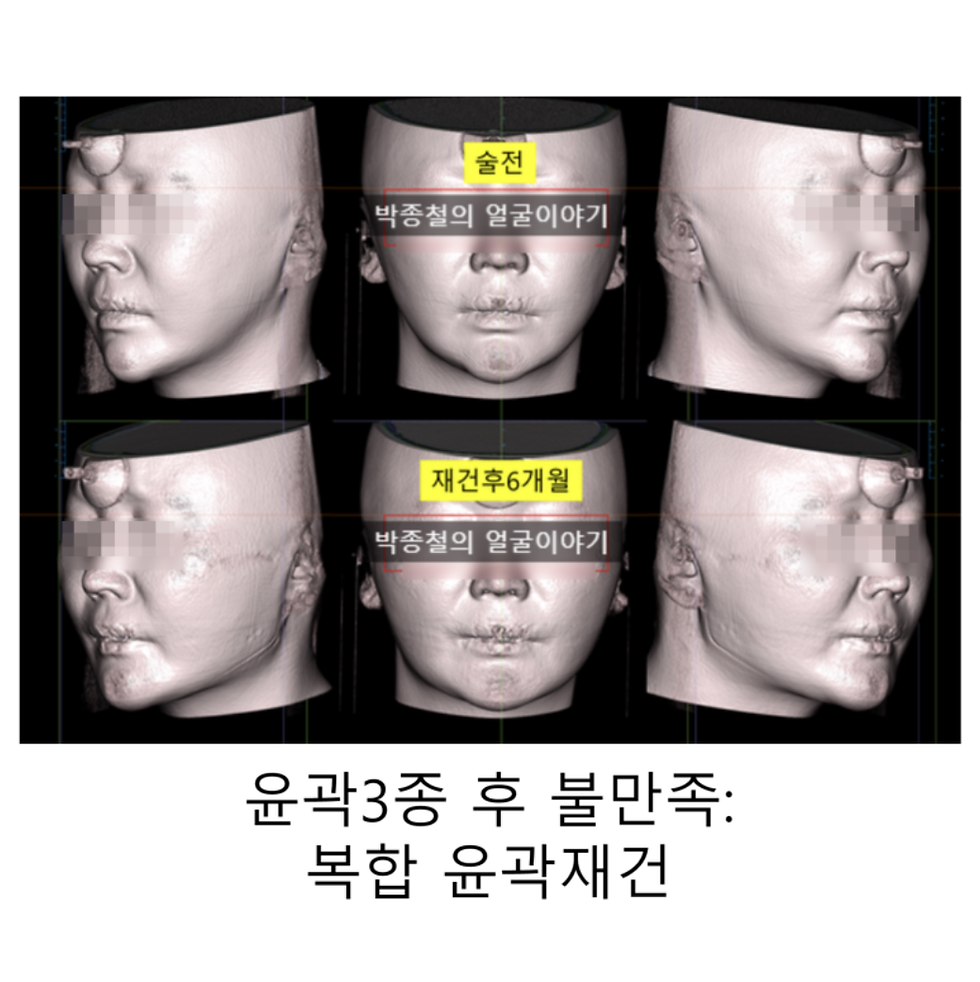
The importance of this volume balance becomes even clearer when we look at cheekbone reconstruction (restoration) cases—patients who had their cheekbones reduced excessively and want to restore volume.
When we restore the bone volume of the 45-degree cheekbone using bone grafts or repositioning, the "sagging" soft tissue appears to lift. The restored bone acts as a "tent pole," supporting the soft tissue once again. This moves the facial highlight point upward, restoring a youthful, vitalized contour.

Strategic Surgical Planning: Considering Both Upper and Lower Zones
To achieve a successful cheekbone reduction without the sagging side effect, simply cutting the bone or pushing it in as much as possible is not the answer. The surgical plan must predict the reduction of upper soft tissue and the response of the lower soft tissue, particularly the buccal fat pad.
3-Dimensional Movement Strategy:
Inward Movement: Reduces the width of the side cheekbones for a slimmer frontal view. (Caution: Excessive inward movement can compress the buccal fat, emphasizing lower volume.)
Backward Movement: Reduces the protrusion of the 45-degree cheekbone. (Caution: Excessive backward movement can make the front cheek look sunken and aged.)
Upward Movement: Naturally accompanies the repositioning; usually, artificial upward fixation is not recommended.
Soft Tissue Management: If the accumulation of lower soft tissue is predicted, procedures such as buccal fat removal or liposuction must be performed simultaneously to reduce the "heaviness" of the lower face.
By controlling the direction of bone movement to maintain the 45-degree dimensionality (the Apple Zone) while reducing width, and managing the lower soft tissue, we can create a youthful, attractive contour without the worry of sagging.

Conclusion
The changes following cheekbone reduction cannot be 100% predicted by looking at bone X-rays alone. A successful surgeon must stereoscopically analyze how bone movement will affect the soft tissue, specifically distinguishing between the upper zygoma (which tends to flatten) and the lower zygoma (which tends to look heavy).
The side effect often mistaken for "sagging" is frequently the result of the upper cheek losing volume while the lower cheek remains prominent.
Therefore, rather than having vague fears about surgery, I recommend consulting with a specialist who precisely analyzes your skin thickness, elasticity, and lower cheek fat volume (buccal fat). A tailored plan that sets the correct amount and direction of bone movement is essential for a safe and beautiful result.
Thank you.



Comments