Double Jaw Surgery Recovery Time: A Surgeon’s 7-Week Timeline (Real Case Study)
- Dr. Park

- Nov 28, 2025
- 3 min read
Hello, this is Dr. Jong-chul Park, an Oral and Maxillofacial Surgeon.
In my consultation room, one of the most frequent questions patients ask—aside from inquiries about surgical outcomes—is regarding double jaw surgery recovery time. Since orthognathic surgery is a major procedure, it is natural to worry about when swelling will subside and when you can return to daily life.
Today, based on a recent case I performed, I will objectively outline the recovery process, focusing on swelling changes and progress from preparation and discharge up to the 7th week post-operation.
Pre-operative Preparation and Hospitalization
You do not need to pack heavily for double jaw surgery. The hospital provides most necessary items during your admission, so please only bring light personal belongings. However, I recommend bringing a hat or a zip-up hoodie to cover your face upon discharge, as some swelling will remain.
Many patients also ask if a guardian (caregiver) is required to stay with them 24/7.
Even immediately after surgery, you are not bedridden for days. From the day after surgery, recovery progresses enough for you to use the restroom or walk in the hallway independently. Therefore, a guardian is not strictly required to stay throughout the entire hospitalization period.
※ Important Note: Guardian Required for Discharge However, you must be accompanied by a guardian on the day of discharge. Even if you feel fine in the hospital, sudden physical weakness or dizziness (such as orthostatic hypotension) can occur while traveling home. For patient safety, discharge without a guardian is restricted.
Double Jaw Surgery Recovery Time: Swelling & Progress by Stage
Swelling after double jaw surgery peaks around day 2 and gradually decreases over time. While individual recovery rates vary, the general flow is as follows:
1. Surgery Day: Compression and Hemostasis
Immediately after surgery, an elastic pressure bandage is applied to the entire face to minimize swelling and bleeding. While the pressure may feel uncomfortable, this is an essential step for early recovery.

2. Day 1 Post-Op: Airway Management and Disinfection
On the day after surgery, patients often complain of stuffiness due to nasal congestion. This is a natural phenomenon caused by edema of the nasal mucosa. During rounds, I use a nasal speculum to clean the inside of the nose, helping the patient breathe more comfortably. We also take X-rays to initially check the condition of the surgical site.


3. Day 2 Post-Op: Precision Evaluation (3D CT)
On the second day, a 3D CT scan is performed. This is a critical step to precisely evaluate whether the jawbones have moved exactly as planned.
Clinical Note: In this specific case, the mandible (lower jaw) was set back by 21.71mm. Despite the significant amount of movement required, the surgery was executed successfully according to the plan.

4. Discharge & Week 1: Swelling Begins to Subside
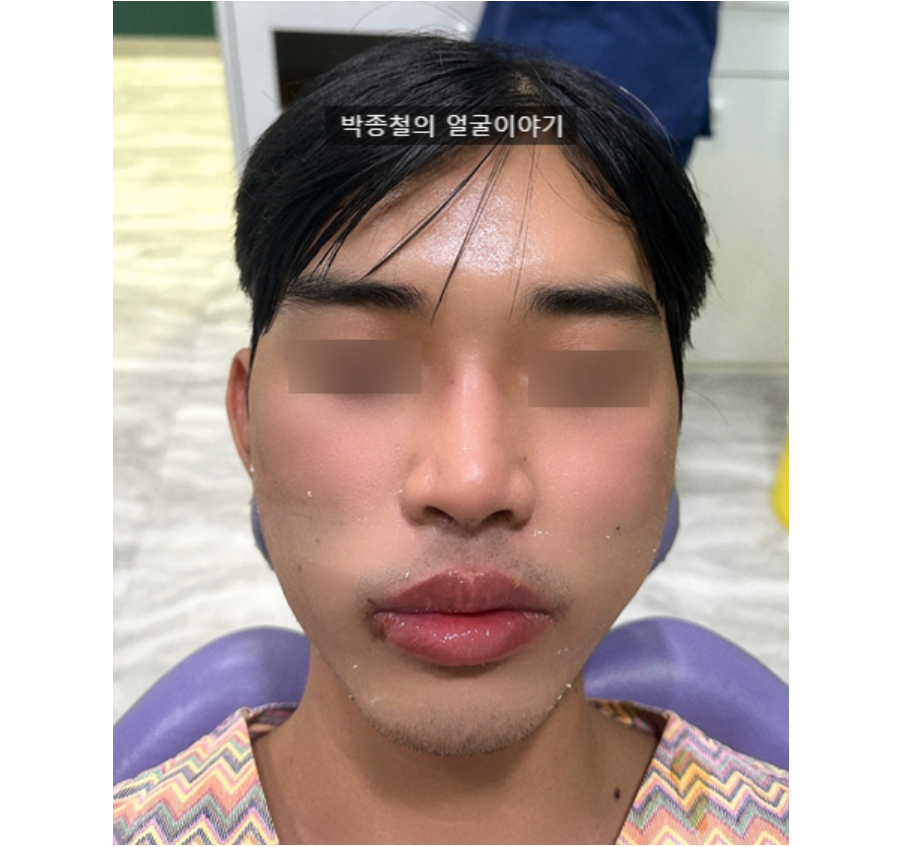
About a week after discharge, the swelling begins to decrease more noticeably. This is the period when patients start to feel and see changes in their facial contour. However, the tissues have not yet fully healed, so you must avoid strenuous activity and focus on rest.

5. Week 5: Return to Daily Routine
By the 5th week, visible swelling is largely resolved. On the follow-up CT scan, we can observe not only the reduction of soft tissue edema but also the reduction of airway swelling (indicated by the red arrow), confirming that breathing has become much more comfortable. A return to daily life is possible at this stage, though intense exercise should still be avoided.

6. Week 7: Contour Stabilization
By week 7, most residual swelling has dissipated, and the facial contours settle naturally. The jawline becomes distinct, and the aesthetic and functional improvements of the surgery become clearly visible.

Conclusion
In double jaw surgery, post-operative care is just as important as the procedure in the operating room.
While double jaw surgery recovery time varies by individual, strictly following post-op instructions and adhering to the follow-up schedule ensures a safe recovery and satisfactory results.
Dr. Jong-chul Park, Oral and Maxillofacial Surgeon.



Comments