3D Titanium Implants for Jawline Restoration and Reconstruction
- Dr. Park

- Apr 8, 2025
- 3 min read
Hello, I am Dr. Jong-Cheol Park, an oral and maxillofacial surgeon. In this post, I will provide a detailed explanation of the 3D facial bone implant design process and actual application examples of titanium reconstruction, focusing on a patient case who desired jawline restoration and reconstruction due to aesthetic dissatisfaction after jawline reduction surgery.
Initial Assessment of Asymmetry
The first step for jawline restoration or reconstruction is to accurately assess the patient's facial asymmetry. In clinical practice, there are many cases where patients feel that their asymmetry has worsened after surgery, but in most cases, inherent asymmetry existed before the surgery. Therefore, before proceeding with restoration, it is essential to establish precise reference coordinate systems to ensure that the original asymmetry is not also restored.
Skeletal Asymmetry Analysis

After setting the reference coordinate system, a precise skeletal asymmetry analysis is performed based on CT data. For example, in cases like this patient, where there is a 7mm difference between the left and right zygomas and an 11mm difference in width between the left and right mandibular angle areas, simply pursuing symmetry may lead to unnatural results. Therefore, it is crucial to design implants that consider the individual's unique asymmetry.
Frontal and Lateral Image Analysis

Since asymmetry may not be clearly visible in 3D images, clinical photographs are used to carefully examine depressed areas and differences in facial width in frontal and lateral views. In particular, the patient desired the jaw angle restoration to be about 15-20mm below the earlobe, and design coordinate settings were established based on this area.
Design Based on Soft Tissue and Skeletal Images

Based on 3D CT data, and using soft tissue coordinates, the skeletal design is initiated to precisely match the patient's desired jaw angle height. The height coordinate values showed a difference of approximately 18mm on both sides based on soft tissue, confirming that they matched the planned reconstruction height.

Design Completion Using CAD Virtual Modeling Program
Subsequently, the primary design is completed using CAD virtual modeling software. In this process, the left and right thicknesses are proportionally adjusted by comprehensively considering both the frontal and lateral views of the jaw angle area. For example, if an implant of the same thickness is applied to a patient with a face width that is 7mm wider on the right side, the right side may appear more prominent. Therefore, the right side is designed to be thinner and the left side thicker to achieve a natural result.

In this process, the left and right thicknesses are proportionally adjusted by comprehensively considering both the frontal and lateral views of the jaw angle area. For example, if an implant of the same thickness is applied to a patient with a face width that is 7mm wider on the right side, the right side may appear more prominent. Therefore, the right side is designed to be thinner and the left side thicker to achieve a natural result.
Final Implant Design and Surgical Guide Fabrication

Based on the modified design, the final implant is precisely manufactured, and a 3D surgical guide is designed to provide guidance for accurate insertion during surgery. This significantly improves the accuracy of implant placement during the operation.

Surgical Results
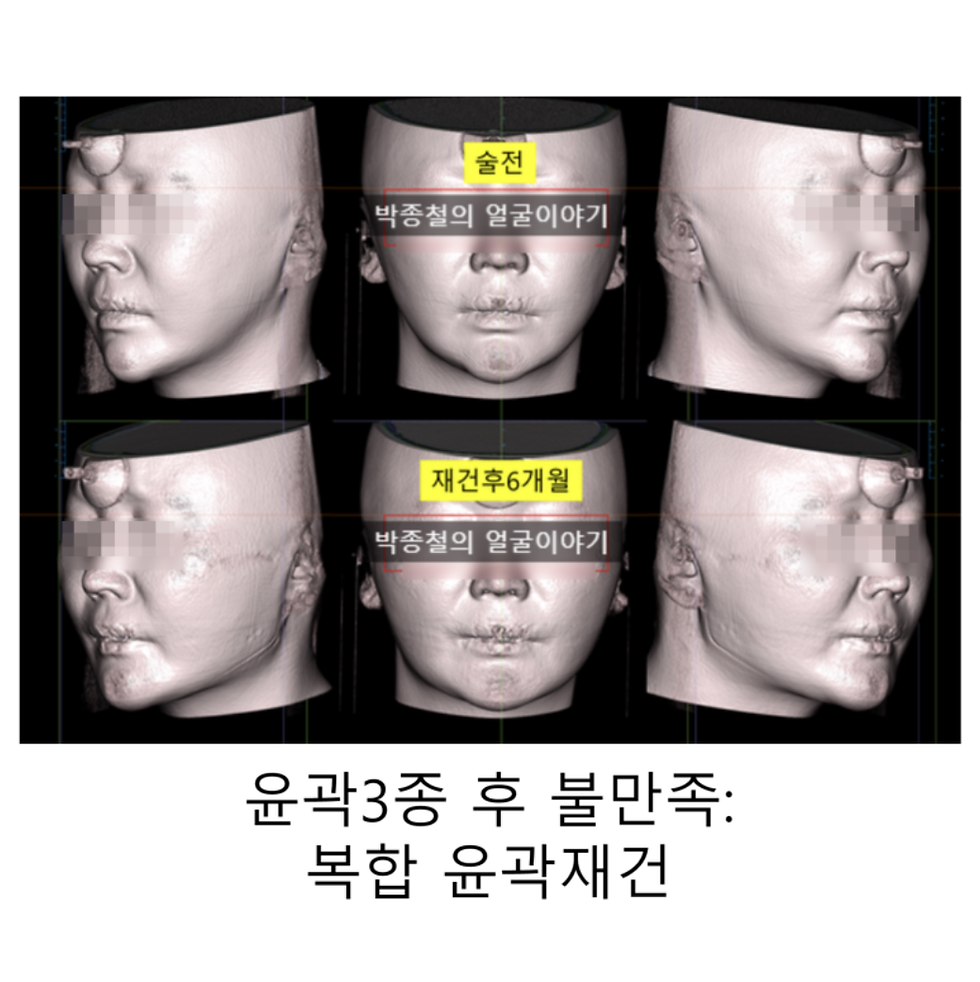
Comparing clinical photographs at 4 months post-surgery, it can be seen that the previously recessed jaw angle area has been accurately restored as planned. The position, thickness, and asymmetry correction of the implant were all performed according to the surgical plan, resulting in a highly satisfactory outcome for the patient.

Conclusion

Through this post, I have explained specific clinical application examples of jawline restoration, jawline reconstruction, and titanium reconstruction. Titanium implants can simultaneously satisfy the individual patient's unique structural characteristics and aesthetic needs, and provide predictable and stable results based on precise 3D design. I promise to continue sharing valuable information centered on actual patient cases in the future. Thank you.

3D Titanium Implants for Jawline Restoration and Reconstruction


Comments